
Blog
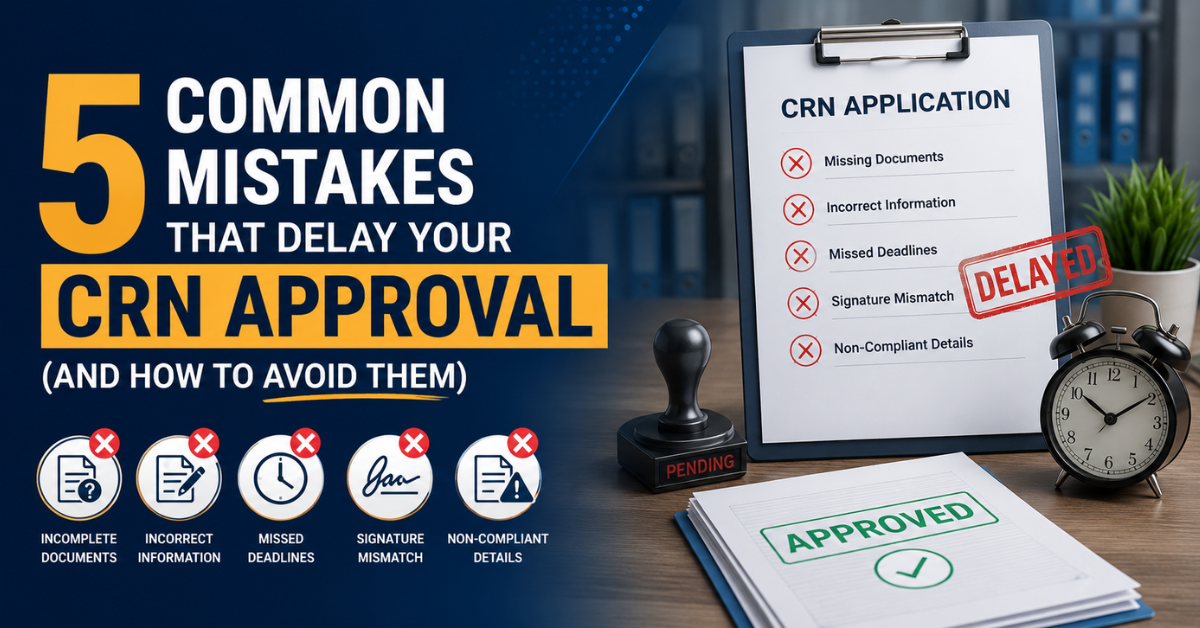
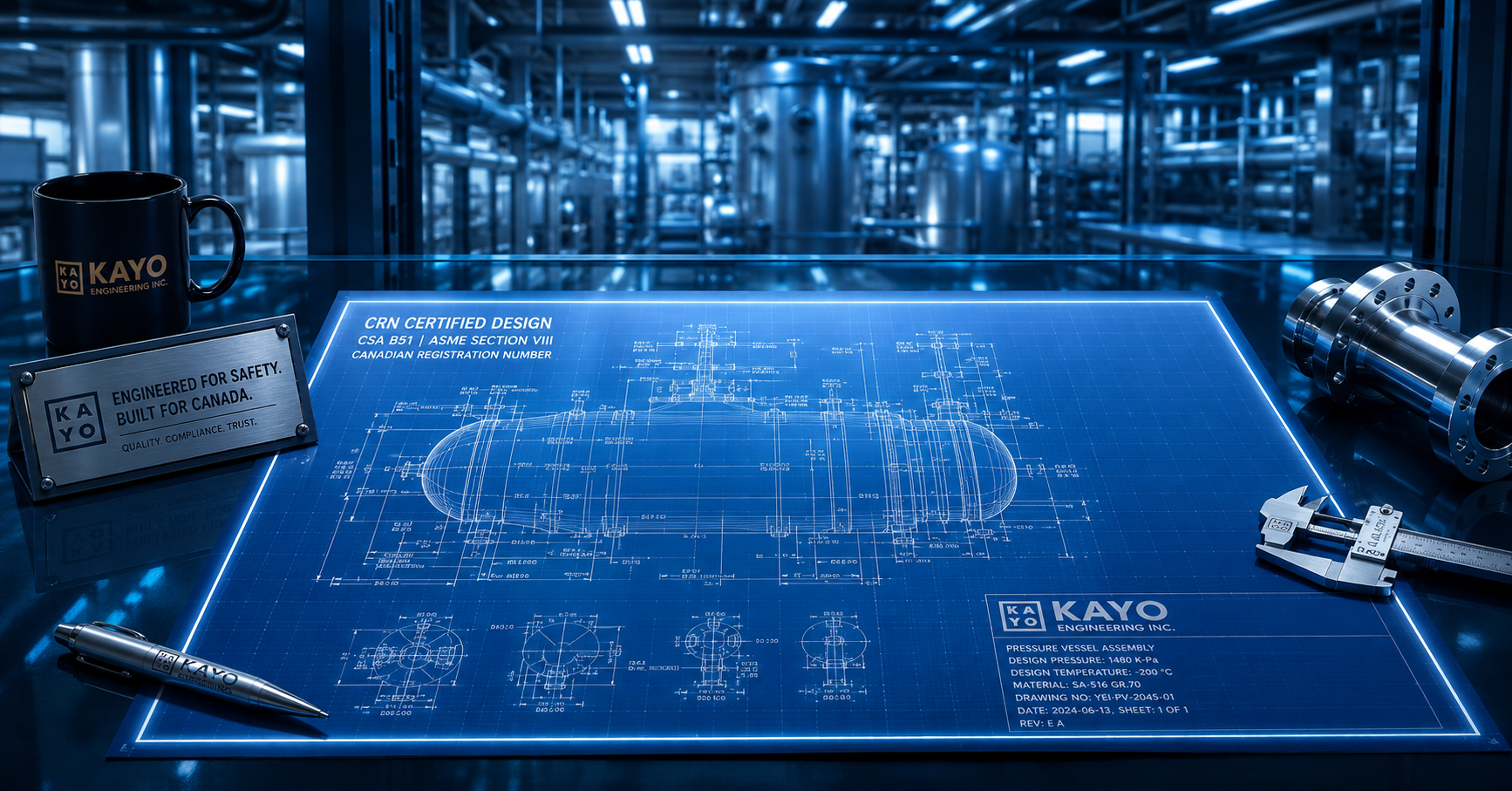
You have designed a state-of-the-art pressure vessel. Your manufacturing team is ready. The client is eager to take delivery. There is just one massive roadblock standing in your way: obtaining your CRN approval.
For manufacturers and engineers dealing with pressure equipment in Canada, the Canadian Registration Number (CRN) process can feel like a labyrinth. A single error in your application can send your design to the back of the queue. This forces you to wait weeks—or even months—for a re-evaluation.
Meanwhile, equipment sits idle on the shop floor. Delivery deadlines are missed. Frustrated clients begin demanding answers. The financial toll of these delays can easily reach tens of thousands of dollars in lost revenue and storage fees.
The good news? The vast majority of CRN application rejections are entirely preventable. By understanding exactly what safety authorities are looking for, you can streamline your submission and get your equipment certified on the first try.
In this comprehensive guide, we are breaking down the five most common mistakes that delay CRN approval. More importantly, we will show you exactly how to avoid them, keeping your projects on schedule and your clients happy.
Understanding the Stakes: Why CRN Approval Matters
Before diving into the mistakes, we must establish why regulatory bodies are so strict. A Canadian Registration Number is not just bureaucratic red tape. It is a critical safety mandate governed by the CSA B51 Boiler, Pressure Vessel, and Pressure Piping Code.
If a piece of pressure equipment fails, the results can be catastrophic. Explosions, chemical leaks, and structural collapses endanger lives and destroy infrastructure. Regulatory bodies like ABSA (Alberta) and TSSA (Ontario) exist to ensure that every vessel, fitting, and piping system can safely handle the pressures and temperatures they are subjected to.
When a reviewer examines your application, they are not just checking boxes. They are legally verifying that your design will not fail under stress. If you leave any room for doubt, they will reject the application. Clarity, completeness, and absolute compliance are your best tools for a fast turnaround.
Mistake #1: Submitting Incomplete or Vague Design Calculations
The absolute most common reason for a delayed CRN approval is incomplete engineering calculations. Your calculations are the mathematical proof that your design is safe. If they are missing, vague, or disorganized, the reviewer cannot validate your equipment.
The Root Cause of the Problem
Many applicants rely heavily on automated software to generate their calculation reports. While software like Compress or PV Elite is incredibly useful, raw software outputs can be difficult to read. Reviewers do not have the time to hunt through hundreds of pages of raw data to find a single variable.
Furthermore, applicants often forget to account for external loads. They might calculate the internal pressure perfectly but completely ignore wind loads, seismic activity, or thermal expansion.
The Regulatory View
Safety authorities require a clear, logical narrative in your calculations. They need to see the exact formulas used, the code references applied, and how you arrived at your final safety margins. If a reviewer has to guess what a specific variable represents, they will issue a formal request for clarification. This resets your timeline.
How to Avoid This Mistake
To ensure your calculations pass seamlessly, treat your submission like a formal engineering textbook.
- Provide a Clear Summary: Always include an executive summary page at the front of your calculation package. List the design pressure, design temperature, corrosion allowance, and the specific codes used.
- Account for All Loads: Double-check that you have calculated for external forces. This includes nozzle loads, seismic factors, wind factors, and snow loads based on the installation location in Canada.
- Annotate Software Outputs: If you use design software, do not just print the raw report. Highlight the key findings, add annotations, and clearly reference the corresponding sections of the ASME code.
- Include Material Properties: Ensure that allowable stress values for all materials are explicitly stated and match the allowable values in ASME Section II.
Mistake #2: Misunderstanding Provincial Nuances
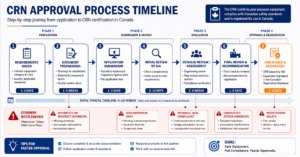
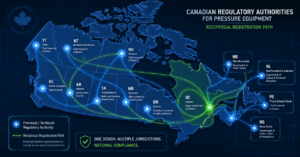
Canada does not have a single, unified federal body that issues CRNs. Instead, pressure equipment regulations are enforced at the provincial and territorial levels. Misunderstanding this fractured system is a massive trap for international and out-of-province manufacturers.
The Root Cause of the Problem
An applicant might successfully obtain a CRN from the Technical Standards and Safety Authority (TSSA) in Ontario. Assuming this covers them nationwide, they ship the equipment to a facility in Alberta. The Alberta Boilers Safety Association (ABSA) halts the installation because the equipment is not registered in their jurisdiction.
Alternatively, an applicant might try to submit the exact same application package to all 13 jurisdictions simultaneously, only to find that some provinces require different specific statutory declaration forms.
The Ripple Effect
Failing to register in the correct province means your equipment is legally prohibited from operating there. If you try to retroactively apply for reciprocal registration without the proper paperwork, you face massive operational delays.
How to Avoid This Mistake
Navigating multi-province registration requires a strategic, standardized approach.
- Determine Your Final Destination: Before you begin the design phase, identify exactly where the equipment will be installed. If you are a manufacturer who sells nationwide, you must plan for registration in all provinces.
- Leverage Reciprocal Registration: You do not have to start from scratch in every province. Once you receive your initial CRN from a primary province, you can use that approval to apply for reciprocal registration in other provinces. This process is generally faster, but only if your initial design package was flawless.
- Use the Correct Forms: Every jurisdiction has its own specific paperwork. ABSA requires the AB-31 form. TSSA requires their specific statutory declaration. Ensure your Quality Control (QC) manager has signed and notarized the exact forms required by the specific province.
Mistake #3: Submitting Un-Stamped or Improperly Stamped Drawings
Your fabrication drawings are the blueprint the manufacturer will follow. For the regulatory reviewer, these drawings must perfectly match the design calculations. One of the fastest ways to get an application thrown out is submitting drawings that lack proper professional authentication.
The Root Cause of the Problem
Many manufacturers submit draft drawings, un-checked CAD files, or drawings that lack a Professional Engineer (P.Eng) stamp. In many Canadian jurisdictions, depending on the size and scope of the equipment, a P.Eng stamp is a strict legal requirement for submission.
Sometimes, a company will use an engineer licensed in a different country, assuming that credential transfers automatically. It does not.
The Regulatory View
To a Canadian safety authority, an unstamped drawing is considered an unverified draft. Without a licensed Canadian Professional Engineer taking legal responsibility for the design, the authority cannot accept it. Furthermore, if the drawing lacks critical details—like weld symbols, non-destructive examination (NDE) requirements, or material specifications—it will be rejected immediately.
How to Avoid This Mistake
Your drawing package must be comprehensive, final, and properly authenticated.
- Engage a Licensed P.Eng Early: Partner with a Professional Engineer licensed in the relevant Canadian jurisdiction early in the design phase. Their review will catch code non-compliances long before you submit to the regulatory body.
- Ensure Drawing Completeness: The drawing must contain every piece of information required to build the vessel safely. This includes a clear bill of materials (BOM), specific material grades (e.g., SA-516 Gr. 70), weld details, and testing requirements (e.g., hydrotest pressure).
- Maintain Version Control: Ensure that the revision number on your drawings matches the revision number referenced in your calculation package. Mismatched revision numbers will cause instant confusion and delay.
Mistake #4: Incorrect Code Identification and Scope
The world of pressure equipment is governed by incredibly dense, complex codes. The two most critical for the Canadian market are the ASME Boiler and Pressure Vessel Code (BPVC) and the CSA B51 standard. Misidentifying the code or the scope of your equipment guarantees a rejection.
The Root Cause of the Problem
A designer might calculate a pressure vessel using ASME Section VIII, Division 1. However, the vessel might actually fall under the scope of a fitting, or it might be part of a larger pressure piping system governed by ASME B31.3.
Another common error is applying an outdated version of the code. The ASME codes are updated frequently, and provincial authorities mandate that you use the most recently adopted edition.
The Financial Impact
If you design and build a vessel to the wrong code, you may be required to completely re-engineer the product. In worst-case scenarios, the physical equipment already built cannot be certified, resulting in a total loss of the manufacturing investment.
How to Avoid This Mistake
Code compliance is black and white. There is no room for interpretation when identifying your primary design standard.
- Identify the Equipment Type Accurately: Clearly define whether you are submitting a pressure vessel, a fitting, a boiler, or a piping system. Each category has different requirements, pressure thresholds, and required codes.
- State the Code Edition: On your drawing and in your calculations, explicitly state the code, the division, and the year of the edition you are using (e.g., “Designed in accordance with ASME Section VIII, Div 1, 2023 Edition”).
- Understand CSA B51: Even if you perfectly design a vessel to ASME standards, it must also comply with CSA B51 to operate in Canada. Ensure you understand the specific Canadian caveats, such as strict requirements for impact testing at low temperatures, which are critical for equipment operating in the Canadian winter.

Mistake #5: Poor Quality Control (QC) Documentation
You can have the most perfectly engineered, beautifully drawn pressure vessel in the world. But if the manufacturing facility lacks the proper quality control certifications, your CRN application will be denied.
The Root Cause of the Problem
A CRN is not just an approval of a design; it is an approval of the manufacturing process that brings that design to life. Authorities need proof that the facility building the equipment has the procedures in place to follow the engineered drawings perfectly.
Many international manufacturers fail to provide adequate proof of their Quality Control program. They may submit an expired ISO 9001 certificate or fail to provide the required statutory declarations signed by an authorized QC manager.
The Regulatory View
If a manufacturer cannot prove they have a valid, audited QC system, the safety authority has no guarantee that the welds will hold or that the materials used match the bill of materials. Therefore, the design cannot be registered to that specific manufacturer.
How to Avoid This Mistake
Your paperwork must clearly link your flawless design to an accredited manufacturing facility.
- Provide Valid Certificates: Always include a copy of the manufacturer’s valid ASME Certificate of Authorization (e.g., U-Stamp) or a recognized equivalent QC certificate (like an audited ISO 9001 program specific to pressure equipment). Ensure the certificate is not expired.
- Properly Execute Statutory Declarations: The statutory declaration must be signed by the person responsible for quality control at the manufacturing facility. It must also be properly notarized by a notary public or commissioner of oaths.
- Consistency is Key: Ensure the manufacturer’s name and address on the QC certificate match exactly with the name and address on the statutory declarations and the fabrication drawings. Even minor spelling discrepancies can cause a reviewer to pause your application.
The Hidden Costs of CRN Delays
It is easy to view a CRN rejection as a simple administrative hurdle. You fix a few typos, add a missing calculation, and resubmit, right? Unfortunately, the reality is much harsher. When your application is pushed to the back of the queue, the hidden costs begin to compound rapidly.
-
The Financial Bleed
Every day your equipment cannot be installed is a day it cannot generate revenue. For major oil and gas or chemical processing facilities, delayed start-ups can cost hundreds of thousands of dollars in deferred production. Furthermore, the manufacturer may be forced to pay exorbitant warehousing fees to store the completed vessel while waiting for the paperwork to clear.
-
Reputational Damage
In the industrial sector, reliability is everything. If you are a manufacturer who continually misses delivery dates because of “paperwork issues,” clients will eventually seek out competitors who have mastered the regulatory landscape. Your inability to secure a CRN quickly signals to buyers that you do not fully understand the Canadian market.
-
Supply Chain Disruption
Modern construction and assembly rely heavily on just-in-time delivery. If a pressure vessel is delayed, it can halt the entire construction schedule. Piping cannot be connected, platforms cannot be finalized, and subsequent contractors are left waiting on site.
The Ultimate CRN Pre-Submission Checklist
To ensure your application sails through the review process, standardize your internal procedures. Do not submit anything to a provincial authority until you can check every single box on this list.
| CRN Application Component | Verification Question | Status |
| Design Calculations | Are all formulas, codes, and external loads (wind/seismic) clearly documented and easy to read? | ☐ |
| Drawings | Are they fully detailed, revision-controlled, and stamped by a licensed P.Eng if required? | ☐ |
| Code Compliance | Is the correct ASME code and year edition clearly stated, alongside CSA B51 compliance? | ☐ |
| QC Documentation | Is a valid, unexpired QC certificate (ASME/ISO) included for the manufacturing facility? | ☐ |
| Statutory Forms | Are the correct provincial forms (e.g., AB-31) signed, dated, and legally notarized? | ☐ |
| Scope & Details | Do the materials listed on the drawing exactly match the materials in the calculations? | ☐ |

Leveraging Expert Help to Eliminate Delays
Even with a perfect checklist, the CRN process is highly technical and constantly evolving. Provincial authorities update their requirements, and ASME codes undergo regular revisions. Attempting to manage this entirely in-house can strain your engineering resources and leave you vulnerable to critical oversights.
This is where partnering with specialized CRN engineering consultants becomes a massive competitive advantage.
Why Use a Dedicated CRN Consultant?
A dedicated consultant acts as a bridge between your manufacturing team and the Canadian regulatory bodies. They speak the language of the reviewers.
- Pre-Submission Audits: Experts will ruthlessly review your calculations and drawings before they ever reach the government authority. They spot the missing wind load calculations or the incorrect weld symbols that would have caused a rejection.
- In-House P.Eng Stamping: Access to licensed Professional Engineers who can validate and stamp your designs, fulfilling the strictest provincial requirements immediately.
- Jurisdictional Navigation: Consultants manage the messy paperwork of reciprocal registration, ensuring your equipment can be legally operated from Alberta to Ontario and beyond.
By removing the guesswork, you transform the CRN approval from a stressful, unpredictable hurdle into a streamlined, predictable step in your supply chain.
Conclusion: Take Control of Your CRN Timeline
Delays in CRN approval are rarely caused by fundamental engineering flaws. They are almost always the result of administrative oversights, vague calculations, misidentified codes, or incomplete paperwork.
By taking a meticulous, textbook approach to your application—ensuring every load is calculated, every drawing is stamped, and every form is correctly notarized—you can eliminate the back-and-forth communication with safety authorities.
Do not let preventable mistakes hold your equipment hostage. Respect the stringent requirements of the CSA B51 standard, understand the nuances of the provincial bodies, and treat your application package with the same precision you apply to manufacturing the vessel itself.
Are you tired of dealing with CRN rejections and delayed project timelines?
Stop leaving your approvals to chance. Ensure your next submission is flawless from day one. Reach out to our team of specialized CRN experts today for a comprehensive design review and let us help you get your equipment registered, approved, and operational without the headache.
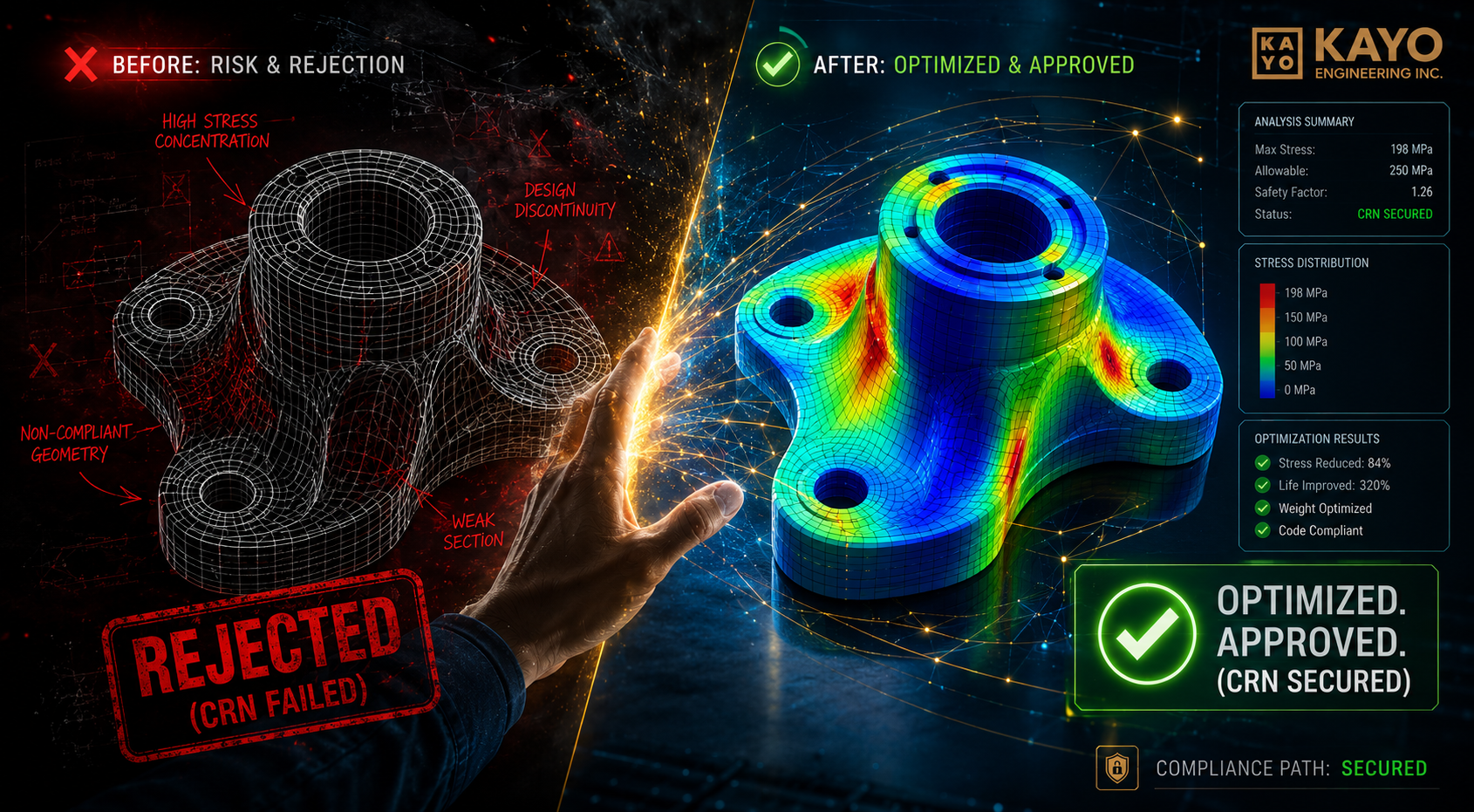
Finite Element Analysis for Complex Geometries: The Ultimate Guide
Standard code calculations form the absolute foundation of mechanical engineering. Governing bodies, such as ASME and CSA, provide highly reliable
The Ultimate Guide to Securing a Canadian Registration Number (CRN) Without the Headaches
Introduction: Why CRN Approval Matters For OEMs, EPC contractors, manufacturers, and industrial facility owners, getting pressure equipment into service in
Industrial Equipment Modification: The Hidden Risks & Solutions
Upgrading your existing machinery seems like the ultimate cost-saving hack. But making structural changes without rigorous engineering validation? That transforms