
Blog
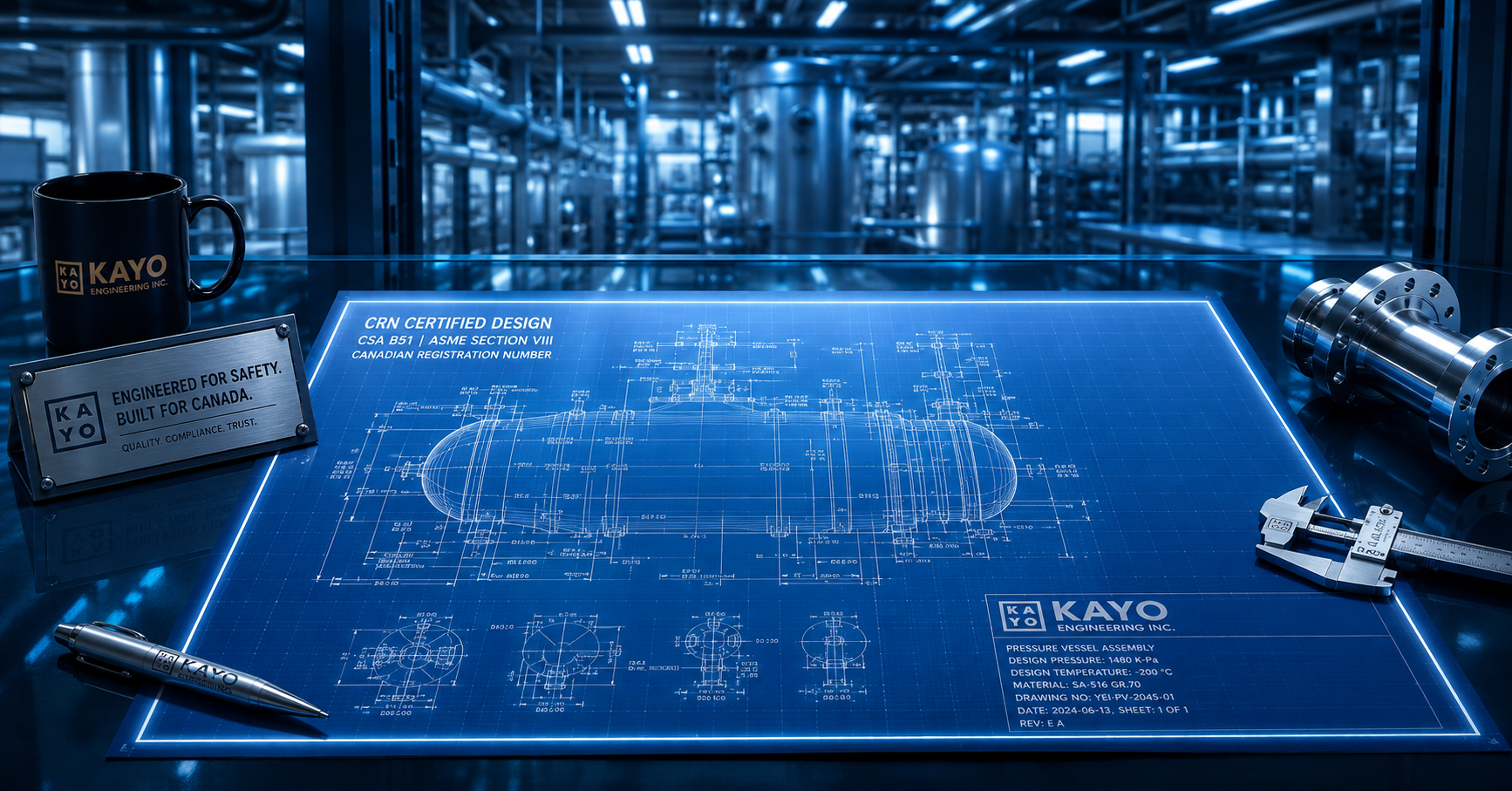
Introduction: Why CRN Approval Matters
For OEMs, EPC contractors, manufacturers, and industrial facility owners, getting pressure equipment into service in Canada involves more than simply designing equipment to an international standard.
A Canadian Registration Number (CRN) is an important part of the pressure equipment registration process in many Canadian jurisdictions. Depending on the equipment and province, registration requirements can apply to boilers, pressure vessels, fittings, and other pressure-retaining components.
For companies unfamiliar with Canada’s regulatory system, the process can feel complicated. Engineering calculations, material specifications, fabrication drawings, quality-control documentation, statutory declarations, and provincial submissions all need to be coordinated correctly.
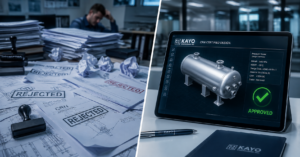
A missing calculation or inconsistent drawing can lead to review comments, additional engineering work, and project delays.
The good news is that the CRN application process becomes much more manageable when the engineering package is prepared correctly from the beginning.
In this guide, KAYO Engineering explains the fundamentals of CRN Canada requirements, the relationship between CSA B51 and ASME codes, the typical registration process, common mistakes, and ways engineering support can help streamline approval.
1. What Is a Canadian Registration Number (CRN)?
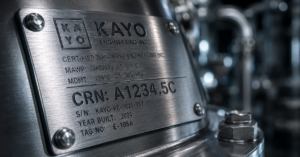
A Canadian Registration Number (CRN) is a registration designation issued by the applicable Canadian provincial or territorial regulatory authority for pressure equipment designs that fall within its jurisdictional requirements.
The purpose of CRN registration is to establish that a pressure equipment design has been reviewed against the applicable codes, standards, and regulatory requirements before the equipment is used in the jurisdiction.
The exact requirements vary depending on the province or territory, equipment type, design, and intended service.
This is why a CRN should not be treated as simply a paperwork exercise. The engineering package behind the application can include:
- Design calculations
- Fabrication drawings
- Material specifications
- Pressure and temperature ratings
- Weld details
- Nondestructive examination requirements
- Quality-control documentation
- Supporting code references
- Statutory declarations and application forms
Understanding CRN Numbers
CRN formats can contain information associated with the registration and jurisdiction, but the exact format and interpretation should always be confirmed with the applicable regulatory authority.
This is important because CRN conventions and registration practices can differ between jurisdictions and equipment categories.
For companies planning to distribute pressure equipment across Canada, understanding the applicable provincial requirements before manufacturing can prevent expensive redesigns and registration delays.
2. CSA B51 and ASME Codes: How Do They Work Together?
One of the most common questions from international manufacturers is:
“If our equipment already complies with ASME, why do we need a CRN in Canada?”
The answer is that ASME compliance and Canadian registration address related but different aspects of pressure equipment compliance.
CSA B51, the Canadian Boiler, Pressure Vessel, and Pressure Piping Code, establishes important Canadian requirements for pressure equipment and interacts with the regulatory frameworks adopted by individual jurisdictions.
ASME codes, meanwhile, provide detailed engineering and construction requirements for specific equipment.
Depending on the design, applicable standards can include:
- ASME Section VIII – Pressure vessels
- ASME Section I – Power boilers
- ASME Section IV – Heating boilers
- ASME B31.1 – Power piping
- ASME B31.3 – Process piping
- ASME Section IX – Welding and brazing qualifications
The applicable code depends on the equipment and its intended service.
Why Design Conditions Matter
Canadian projects can also involve demanding environmental conditions, particularly in colder regions.
Parameters such as:
- Maximum Allowable Working Pressure (MAWP)
- Minimum Design Metal Temperature (MDMT)
- Material toughness
- Corrosion allowance
- Design temperature
- External pressure
- Fatigue considerations
may all affect the engineering design.
A properly prepared CRN package therefore needs to demonstrate more than simply stating which ASME code was used. The engineering calculations and drawings should clearly show how the design satisfies the applicable requirements.
3. Which Equipment May Require a CRN?
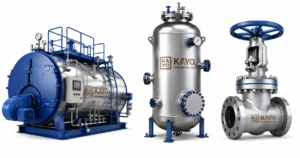
Not every component in an industrial facility automatically requires a CRN. Requirements depend on the equipment, pressure conditions, applicable regulations, and jurisdiction.
Common categories include:
Boilers
Boilers used for generating or transferring heat under regulated pressure conditions may fall under provincial registration requirements.
Examples include:
- Industrial power boilers
- Heating boilers
- Process boilers
- Specialized steam-generating equipment
Pressure Vessels
Pressure vessels are another major category.
Examples include:
- Air receivers
- Compressor vessels
- Heat exchangers
- Separators
- Reactors
- Process vessels
- Certain storage vessels
Pressure-Retaining Fittings
Certain pressure-retaining fittings may also require registration depending on the jurisdiction and applicable standards.
These can include components such as:
- Pipe fittings
- Flanges
- Valves
- Expansion joints
- Strainers
- Filters
- Pressure-related devices
- Other pressure-retaining components
Don’t Assume Every Component Requires Registration
This is where professional engineering guidance becomes valuable.
Some jurisdictions have specific exemptions or simplified requirements for particular standardized components.
Instead of assuming that every valve, fitting, vessel, or piping component needs a CRN, manufacturers should determine the exact requirements for the equipment type, province, pressure conditions, and applicable code before starting the application.
4. What Happens If Pressure Equipment Is Not Properly Registered?

Pressure equipment compliance is not something manufacturers should address after installation.
Failure to meet applicable registration requirements can create significant project and operational risks.
1. Project Delays
If registration is missing or an application is incomplete, equipment may not be ready for installation or operation when the project requires it.
For EPC projects, even a small regulatory delay can affect commissioning schedules and downstream activities.
2. Additional Engineering Costs
A poorly prepared application can result in repeated revisions to:
- Drawings
- Calculations
- Material specifications
- Weld documentation
- Supporting engineering reports
This increases both engineering hours and project costs.
3. Installation and Operational Issues
Installing equipment before confirming the applicable regulatory requirements can create problems during inspections, commissioning, or acceptance.
4. Commercial and Contractual Risk
Many industrial projects require documented regulatory compliance before equipment can be accepted.
For manufacturers competing for Canadian projects, having a clear CRN strategy can therefore become an important commercial advantage.
Safety should always remain the primary reason for compliance. Pressure equipment failures can have serious consequences for workers, facilities, and the environment.
5. The CRN Application Process: Step by Step
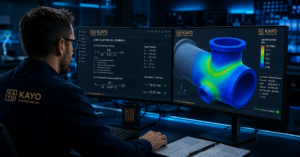
A successful CRN application process begins well before the application reaches a provincial regulator.
Step 1: Identify the Applicable Codes
Engineers first determine which codes and standards apply to the equipment.
This may involve reviewing:
- Equipment type
- Design pressure
- Design temperature
- Fluid service
- Materials
- Geometry
- Intended province of installation
Step 2: Perform Engineering Calculations
The pressure-retaining components must be evaluated using the applicable design rules.
Calculations may cover:
- Shell thickness
- Head thickness
- Nozzle reinforcement
- Flanges
- External pressure
- Supports
- Structural attachments
- Other critical components
For complex geometries, Finite Element Analysis (FEA) may be appropriate where permitted by the applicable code and regulatory requirements.
Step 3: Prepare Engineering Drawings
The drawings should be detailed enough for both manufacturing and regulatory review.
Depending on the equipment, they may identify:
- MAWP
- MDMT
- Design temperature
- Material grades
- Corrosion allowance
- Weld details
- NDE requirements
- Testing requirements
- Relevant code references
Step 4: Compile Quality Documentation
The application may require supporting documentation relating to the manufacturer’s quality system, welding procedures, material traceability, and other manufacturing controls.
Step 5: Submit the Application
The completed engineering package is submitted to the appropriate provincial or territorial authority according to its current submission requirements.
Step 6: Respond to Technical Review Comments
Regulatory reviewers may request clarification or additional information.
A fast response is important, but accuracy matters even more. Every response should address the reviewer’s technical question clearly and consistently with the submitted drawings and calculations.
Step 7: Receive Registration and Address Additional Jurisdictions
Once the design is accepted by the applicable authority, the registration can proceed according to the jurisdiction’s requirements.
If equipment will be used in multiple provinces, additional registrations or acceptance steps may be required.
6. Understanding Provincial CRN Requirements

Canada does not have one single centralized pressure equipment approval process.
Provincial and territorial authorities administer their own regulatory requirements, which means manufacturers must understand the jurisdiction where their equipment will be installed or operated.
Three commonly encountered authorities include:
ABSA – Alberta
The Alberta Boiler Safety Association (ABSA) administers pressure equipment safety requirements in Alberta.
Alberta’s large industrial and energy sectors mean that pressure equipment projects can involve detailed engineering and documentation requirements.
TSSA – Ontario
The Technical Standards and Safety Authority (TSSA) administers pressure equipment requirements in Ontario.
Manufacturers need to ensure that applications and supporting documentation meet the authority’s current submission and technical requirements.
TSBC – British Columbia
Technical Safety BC (TSBC) administers pressure equipment safety requirements in British Columbia.
Specific exemptions and requirements can apply depending on equipment type and applicable standards.
One Province Does Not Always Mean All Provinces
A common mistake is assuming that approval in one province automatically provides unrestricted approval everywhere in Canada.
It is better to determine the intended jurisdictions before engineering and manufacturing are finalized.
This allows the design package to be prepared with the broader regulatory strategy in mind.
7. Common CRN Application Mistakes
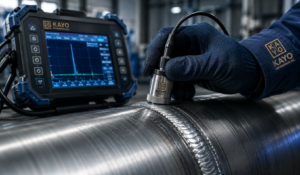
Many CRN delays are avoidable.
The following problems frequently create additional questions or engineering revisions.
Incomplete Calculations
Submitting only basic calculations while leaving complex components unsupported can weaken an application.
Reviewers need sufficient engineering evidence to evaluate the design.
Inconsistent Drawings and Calculations
One of the simplest mistakes is having different values on different documents.
For example, the design pressure shown on the drawing should match the calculation package and application documentation.
Incorrect Material Information
Material grades should be clearly identified and supported by the required documentation.
Material selection is especially important when temperature, pressure, corrosion, or toughness requirements affect the design.
Missing Welding Documentation
Applicable Welding Procedure Specifications (WPS) and Procedure Qualification Records (PQR) should be properly prepared and referenced where required.
Poor Revision Control
A drawing revision that does not match the submitted calculation package can create unnecessary questions.
A professional document-control system can prevent this problem.
8. How Engineering Support Can Speed Up CRN Approval
Preparing a CRN application internally may seem straightforward until the engineering and regulatory requirements start to overlap.
An experienced engineering partner can help reduce that complexity by coordinating the technical package before submission.
Design Review Before Submission
Instead of waiting for a regulatory reviewer to identify design problems, engineers can conduct an internal review first.
This can include checking:
- Pressure calculations
- Material selection
- Nozzle design
- Weld details
- MDMT
- MAWP
- Drawings
- Code references
Clear, Audit-Ready Calculations
Well-organized calculations make it easier for a reviewer to understand how the design satisfies the applicable requirements.
Clear engineering documentation can also reduce unnecessary back-and-forth.
Regulatory Coordination
CRN applications involve more than calculations.
They can also involve forms, declarations, drawings, quality documentation, correspondence, and revisions.
Having one engineering team coordinate these elements can make the process more organized and predictable.
Support for Complex Designs
Custom pressure vessels, unusual geometries, specialized piping components, and equipment requiring advanced analysis may require additional engineering expertise.
KAYO Engineering can help manufacturers and project teams develop engineering documentation designed around the applicable Canadian requirements.
9. CRN Approval FAQ
How long does CRN approval take?
There is no universal CRN approval timeline.
Review time depends on the jurisdiction, equipment type, application complexity, submission quality, and regulatory workload.
A complete application with consistent calculations and drawings is generally easier to review than one requiring repeated corrections.
For this reason, manufacturers should build regulatory review time into the project schedule rather than treating CRN registration as an afterthought.
Does a CRN expire?
The answer depends on the type of registration and jurisdiction.
Some registrations may have renewal requirements, particularly for certain fittings or components. Other equipment registrations may remain valid subject to applicable conditions.
Always confirm the current requirements with the relevant authority.
Can FEA be used for CRN applications?
FEA can be used for certain complex engineering evaluations when supported and permitted by the applicable design code and regulatory requirements.
For pressure vessels, the analysis may need to address factors such as:
- Mesh quality
- Boundary conditions
- Stress classification
- Stress linearization
- Fatigue
- Material properties
- Load cases
The analysis must be properly documented and technically defensible.
Does equipment manufactured outside Canada need a CRN?
Manufacturing location does not automatically eliminate Canadian registration requirements.
If pressure equipment is intended for use in a Canadian jurisdiction where registration is required, the manufacturer should determine the applicable CRN requirements before production.
Foreign manufacturers may also need to provide additional quality, manufacturing, or statutory documentation.
What happens if I change an approved design?
It depends on the nature and significance of the change.
Changes to pressure-retaining components, materials, operating conditions, or critical geometry may require regulatory review or a design revision.
Even seemingly minor changes should be assessed before manufacturing modified equipment.
Conclusion: Make CRN Compliance Part of Your Engineering Strategy
Securing a Canadian Registration Number does not have to become a last-minute project obstacle.
The key is preparation.
When the applicable CSA B51 and ASME requirements are identified early, engineering calculations are complete, drawings are consistent, materials are properly documented, and provincial requirements are considered from the beginning, the CRN application process becomes much more manageable.
For OEMs, manufacturers, EPC contractors, and industrial operators, this approach can reduce unnecessary revisions and help keep equipment projects moving toward installation and commissioning.
The most effective CRN strategy is not simply about submitting paperwork quickly. It is about submitting a technically sound, complete, and well-organized engineering package the first time.
If you are preparing pressure equipment for the Canadian market, KAYO Engineering can help you evaluate your design, prepare the required engineering documentation, and develop a practical strategy for the applicable CRN requirements.
Ready to simplify your CRN application?
Contact KAYO Engineering to discuss your pressure equipment design, engineering documentation, and Canadian registration requirements with experienced mechanical engineering professionals.
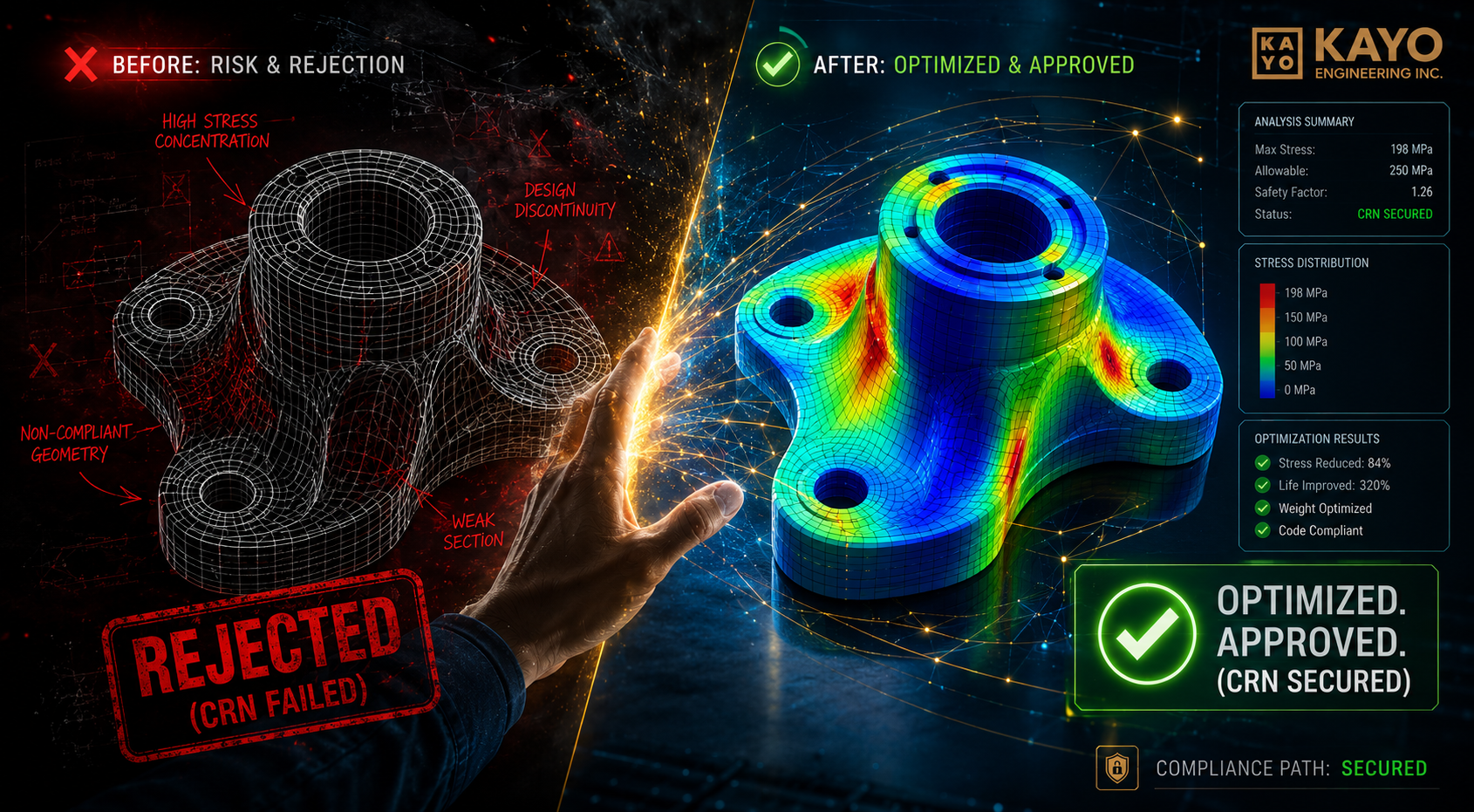
Finite Element Analysis for Complex Geometries: The Ultimate Guide
Standard code calculations form the absolute foundation of mechanical engineering. Governing bodies, such as ASME and CSA, provide highly reliable
Industrial Equipment Modification: The Hidden Risks & Solutions
Upgrading your existing machinery seems like the ultimate cost-saving hack. But making structural changes without rigorous engineering validation? That transforms

Live Leak Sealing: Repair Pressurized Pipeline Leaks Without Plant Shutdowns
Every year, industrial facilities lose millions—sometimes billions across the industry—because of one preventable problem: unplanned shutdowns. Even a small leak