
Blog
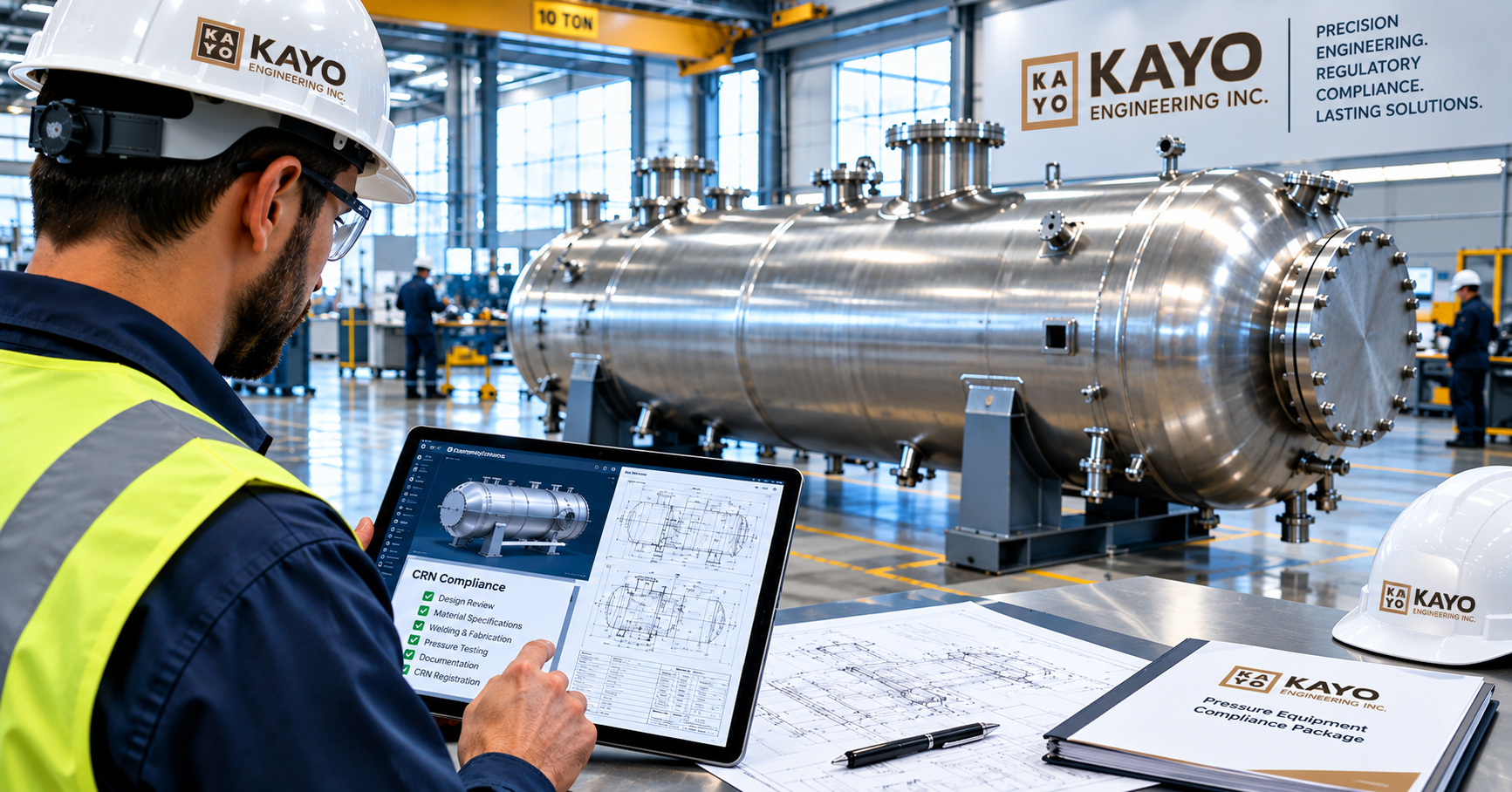
Imagine this scenario: Your state-of-the-art pressure vessel is fully manufactured. It has passed every internal quality check. The welds are flawless, the hydro-testing is complete, and it is sitting on the loading dock ready to be shipped to your most important client in Canada.
But it’s not going anywhere.
Instead, it sits gathering dust, costing you daily storage fees, delaying your client’s facility launch, and triggering severe contractual penalties. The culprit? A rejected or delayed Canadian Registration Number (CRN) application.
In the Canadian pressure equipment industry, regulatory red tape is not just an administrative hurdle; it is a financial minefield. Every day your equipment waits for regulatory approval is a day you hemorrhage money.
Navigating the CRN process is notoriously complex. Canada does not have a single federal body that issues a nationwide safety stamp. Instead, regulations shift the moment you cross provincial lines. What passes seamlessly in Alberta might trigger a massive audit in Ontario.
In this ultimate guide, we are demystifying the entire Canadian Registration Number process. We will break down the exact steps to take, the hidden traps to avoid, the intricacies of provincial jurisdictions, and how partnering with an expert firm like KAYO Engineering can fast-track your approvals and protect your bottom line.
📌 TL;DR: The Executive Summary
Short on time? Here are the core takeaways you need to know before deploying pressure equipment in Canada:
- It is the Law: A CRN is legally required for boilers, pressure vessels, pressure piping, and fittings operating in Canada. Operating without one can lead to massive fines, facility shutdowns, and nullified insurance policies.
- Provincial Fragmentation: There is no “National CRN.” You must apply to the specific regulatory authority in every individual province where the equipment will be installed or sold.
- Fittings vs. Vessels: Fittings are categorized into eight distinct groups (Categories A through H), each with specific registration requirements.
- The Top Delay Triggers: Poor material traceability, missing design calculations, and invalid Quality Control (QC) certificates are the top reasons applications are rejected.
- Proactive Engineering is Key: The most successful fabricators integrate CRN compliance into the initial design phase, not as an afterthought.
- Expert Help Saves Money: Outsourcing the bureaucratic maze to KAYO Engineering eliminates guesswork, prevents mandatory rework, and accelerates project timelines.
Chapter 1: What Exactly is a Canadian Registration Number (CRN)?
At its core, a Canadian Registration Number (CRN) is an alphanumeric identifier issued by a provincial or territorial safety authority.
This number signifies that the design of a boiler, pressure vessel, or fitting has been rigorously reviewed and accepted as meeting the safety standards mandated by the CSA B51 Boiler, Pressure Vessel, and Pressure Piping Code.
The Anatomy of a CRN
A CRN is not just a random string of numbers. It is a highly specific code that tells a story about the equipment, its approval sequence, and where it is legally allowed to operate.
Let’s break down a hypothetical CRN: M1234.5678
- The Prefix: Sometimes a letter is used (like ‘M’ or ‘F’) to denote the type of equipment (e.g., Fitting).
- The Base Number (1234): This is the unique registration number assigned by the very first province that reviewed and approved the design.
- The Decimal Point (.): This separates the base number from the provincial identifiers.
- The First Digit After the Decimal (5): This represents the province that issued the initial approval. (In Canada’s system, ‘5’ represents Ontario).
- The Subsequent Digits (6, 7, 8): These represent the other provinces that have subsequently accepted the initial registration.
The Provincial Code Breakdown
To read a CRN, you need to know the provincial identifiers. Here is the legend:
- 1 – British Columbia
- 2 – Alberta
- 3 – Saskatchewan
- 4 – Manitoba
- 5 – Ontario
- 6 – Quebec
- 7 – New Brunswick
- 8 – Nova Scotia
- 9 – Prince Edward Island
- 0 – Newfoundland and Labrador
- T – Northwest Territories
- Y – Yukon
- N – Nunavut
The “C” Identifier: If you see the letter C after the decimal (e.g., M1234.5C), it means the design has been registered in all provinces and territories across Canada. This is the ultimate goal for manufacturers producing standard, mass-market fittings.
Chapter 2: Why is the CRN Process So Fragmented?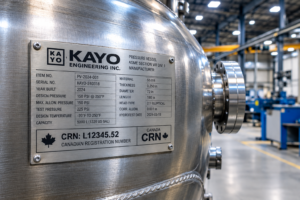
To understand the frustration of the CRN process, you have to understand a brief bit of Canadian legal history.
Under the Canadian Constitution, public safety is a matter of provincial jurisdiction, not federal. Therefore, the federal government cannot mandate a single, nationwide safety standard for pressure equipment.
While the provinces have universally adopted the CSA B51 code and the ASME Boiler and Pressure Vessel Code (BPVC) as their technical baselines, the administration, enforcement, and review of these codes are entirely localized.
This means a design engineer sitting in Texas, Italy, or Germany must understand that sending equipment to Alberta requires dealing with ABSA, while sending that exact same equipment to Ontario requires dealing with the TSSA.
The Financial Impact of Fragmentation
Because each province has its own governing body, each province also has its own fee structure, wait times, application forms, and specific documentation quirks.
If you are a manufacturer wanting to sell a new type of safety valve nationwide, you must pay registration fees to multiple different authorities, fill out multiple different statutory declarations, and answer to multiple different review engineers who might interpret the ASME code slightly differently.
Chapter 3: Boilers, Vessels, vs. Fittings (The A-H Categories)
Not all pressure equipment is treated equally under the CRN system. Registration requirements differ drastically depending on what you are building. Generally, equipment falls into three main buckets: Boilers, Pressure Vessels, and Fittings.
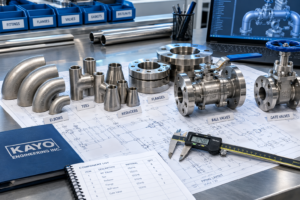
Fittings are the most common and often the most confusing to register because they are broken down into eight specific categories (Category A through H). Understanding these categories is critical for your application.
The 8 Categories of Fittings
- Category A: Pipe fittings, including couplings, tees, elbows, wyes, plugs, unions, pipe nipples, and pipe caps.
- Category B: All flanges.
- Category C: All line valves (gate, globe, ball, check, etc.).
- Category D: Expansion joints, flexible connections, and hose assemblies.
- Category E: Strainers, filters, separators, and steam traps.
- Category F: Measuring devices, including pressure gauges, level gauges, sight glasses, levels, and pressure/temperature transmitters.
- Category G: Certified capacity-rated pressure relief devices acceptable as primary overpressure protection on boilers and pressure vessels.
- Category H: Pressure-retaining components that do not fall into Categories A to G. (This is a catch-all category for complex, custom assemblies and manifolds).
Why does the category matter?
Because the volume of engineering proof required scales with the complexity of the category. A simple Category A elbow requires far less mathematical justification than a complex Category H custom gas manifold. Misclassifying your fitting on the application is an instant recipe for rejection.
Chapter 4: Deep Dive into Key Provincial Jurisdictions
To succeed in the CRN game, you must know your audience. Let’s look at the “Big Three” regulatory authorities where the majority of Canadian industrial activity happens, plus the Maritimes.
1. Alberta: ABSA (Alberta Boilers Safety Association)
Alberta is the heart of Canada’s oil, gas, and petrochemical industry. Consequently, ABSA handles a massive volume of highly complex pressure vessel registrations.
- The Vibe: Highly technical, strictly by-the-book.
- The Challenge: ABSA reviewers are notorious for diving deep into your math. If your design calculations do not explicitly list the specific ASME code paragraphs used to justify every single component, you will be flagged. They do not tolerate assumptions.
- Pro-Tip: Ensure your Finite Element Analysis (FEA) reports are flawlessly documented if you are stepping outside standard ASME formulaic design.
2. Ontario: TSSA (Technical Standards and Safety Authority)
Ontario boasts a massive manufacturing, nuclear, and commercial sector.
- The Vibe: Heavily focused on Quality Control and bureaucratic perfection.
- The Challenge: The TSSA places immense scrutiny on the manufacturer’s Quality Control program. If your ISO 9001 certificate is expiring in a month, or if the scope of your certificate does not explicitly state the manufacturing of the specific fitting you are applying for, they will halt the process.
- Pro-Tip: TSSA requires physical, original notarized Statutory Declarations to be mailed in many cases, whereas some provinces accept digital copies. (Though digital transformation is slowly happening, always double-check current TSSA mail policies).
3. Quebec: RBQ (Régie du bâtiment du Québec)
Quebec has a strong industrial base, but comes with unique provincial requirements.
- The Vibe: Stringent adherence to local administrative laws, heavily focused on language requirements.
- The Challenge: Under the Charter of the French Language, interactions with government bodies often require documentation to be available in French. While technical drawings and ASME calculations are usually accepted in English, administrative forms and declarations may require translation.
- Pro-Tip: Never assume your English-only application will breeze through Quebec without first checking the RBQ’s current language mandates for commercial entities.
4. The Maritimes: ACI Central
To simplify matters in Eastern Canada, several provinces banded together.
- The Vibe: Cooperative.
- The Challenge: ACI Central handles registrations for Prince Edward Island, Nova Scotia, New Brunswick, Newfoundland and Labrador, Yukon, Northwest Territories, and Nunavut. This is a massive time-saver. You submit one application to ACI Central, and they manage the registration for all participating regions.
Chapter 5: The True Cost of Non-Compliance and Delays
Some manufacturers view the CRN process as an annoying checklist item that can be rushed at the end of a project. This mindset destroys profit margins.
Here is what actually happens when you delay your CRN strategy:
1. The Rework Nightmare
If you build a vessel before the CRN is issued, you are gambling. If the ABSA or TSSA review engineer decides that your flange thickness calculation is insufficient, they will mandate a thicker flange.
If the vessel is already built, you now have to cut off the old flange, buy new material, weld the new flange, conduct non-destructive testing (NDT) on the new weld, hydro-test the entire vessel again, and re-paint it. You have just destroyed your entire profit margin for the job.
2. Supply Chain Gridlock
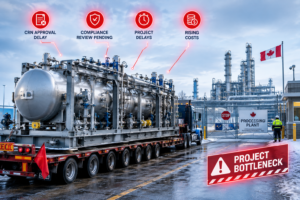
Your client cannot legally operate the equipment without the CRN. If your skid package arrives at a site in Fort McMurray, Alberta without its paperwork, the local inspector will red-tag it. It will sit in the snow while construction crews wait. Your client will likely enforce liquidated damages (financial penalties for late delivery) against your company.
3. Legal and Insurance Liabilities
Operating pressure equipment without a valid CRN is illegal. If an accident occurs—even a minor leak—and the equipment lacks a CRN, the facility’s insurance policy is almost certainly voided. The legal liability will immediately trace back to the manufacturer and the installing contractor.
Chapter 6: The 7 Most Common CRN Rejection Pitfalls
Avoid these seven deadly sins, and your CRN application will move smoothly through the queue.
Pitfall 1: Incomplete or Disorganized Design Calculations
Review engineers review dozens of applications a week. If you submit a massive PDF of raw math with no table of contents, no clear material properties, and no referenced ASME code paragraphs, they will reject it out of frustration.
- The Fix: Structure your calculation packages like a textbook. Include a summary page. Highlight allowable stresses. Clearly link every calculation to its specific component on the drawing.
Pitfall 2: Ambiguous Material Traceability
You cannot simply write “Carbon Steel” or “Stainless Steel” on your Bill of Materials (BOM).
- The Fix: You must use exact ASME/ASTM material designations (e.g., SA-106 Grade B, SA-312 TP316L). Furthermore, the allowable stress values in your calculations must perfectly match the exact year and edition of the ASME Section II code you are referencing.
Pitfall 3: Uncertified Quality Control Programs
To get a CRN for a fitting, the manufacturing facility must have a recognized QC program.
- The Fix: You need a valid ISO 9001 certificate or an ASME stamp (like a ‘U’ or ‘S’ stamp). Crucially, the “Scope” on your ISO certificate must actually describe what you are building. If your ISO certificate says “Manufacturer of office furniture” but you are applying for a pressure valve CRN, it will be rejected.
Pitfall 4: Outdated Code Editions
The ASME codes update frequently. If you submit calculations based on the 2019 ASME code, but the province has already legally adopted the 2023 edition, your math is invalid.
- The Fix: Always verify the latest adopted code editions with the provincial authority before you begin your engineering design.
Pitfall 5: Incorrectly Filled Statutory Declarations
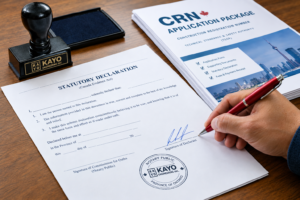
For fittings, an officer of the manufacturing company must sign a Statutory Declaration swearing that the products are built to the submitted designs.
- The Fix: This document often must be notarized by a notary public. A simple typo, a missing stamp, or an unauthorized signature will bounce the entire application.
Pitfall 6: Misuse of FEA (Finite Element Analysis)
When standard ASME formulas cannot prove a complex design, engineers turn to FEA. However, regulatory bodies are highly suspicious of bad FEA models.
- The Fix: If you submit FEA, it must strictly adhere to the guidelines of ASME Section VIII, Division 2, Part 5. You cannot just submit colorful stress plots; you must provide mesh convergence studies, boundary condition justifications, and linearization paths.
Pitfall 7: Ignoring the “Code of Construction” Boundaries
Mixing and matching codes is dangerous. If you are designing to ASME Section VIII Div 1, you cannot suddenly borrow a convenient formula from a European EN code without immense, documented justification and prior approval.
Chapter 7: The Step-by-Step Blueprint to a Flawless Application
Want to get it right the first time? Follow this exact blueprint.
Step 1: Define the Scope and Jurisdiction
Before drawing a single line in AutoCAD, ask your client: Where is this equipment going? If it’s a fitting destined for nationwide distribution, prepare for a multi-province submission. If it’s a single vessel going to a refinery in Sarnia, focus entirely on the TSSA.
Step 2: Establish the Code of Construction
Determine if you are designing to ASME Section VIII Div 1 (Vessels), ASME B31.1 (Power Piping), or ASME B31.3 (Process Piping). Verify the exact year and edition currently adopted by the target province.
Step 3: Produce CRN-Ready Drawings
Your engineering drawings must include specific CRN data blocks. This includes:
- Design Pressure and Design Temperature.
- Minimum Design Metal Temperature (MDMT).
- Corrosion Allowance.
- Exact material specifications.
- Weld details and NDE (Non-Destructive Examination) requirements.
- The Code of Construction and year of edition.
Step 4: Compile the Engineering Package
Assemble your math. Whether you are using software like Compress, PV Elite, or doing hand calculations for a custom fitting, ensure every output is clean, readable, and cross-referenced to the drawing.
Step 5: Prepare the Administrative Paperwork
Gather your QC certificates (ISO 9001), fill out the provincial application forms, and have your Statutory Declarations legally notarized.
Step 6: Submit and Communicate
Submit the package according to the province’s preferred method (most have moved to digital portals). If a review engineer reaches out with a question, reply immediately and with immense detail. The faster you clarify their doubts, the faster they stamp your drawing.
Chapter 8: Why Outsourcing to KAYO Engineering is the Ultimate Growth Hack
Let’s be honest: You are in the business of manufacturing high-quality equipment, innovating new products, and serving your clients. You are not in the business of spending hundreds of hours reading provincial bureaucratic updates.
Navigating the CRN process in-house drains your engineering department’s time and risks massive delays if your team isn’t intimately familiar with current provincial quirks.
The KAYO Engineering Advantage
At KAYO Engineering, we act as your dedicated regulatory and engineering department. We specialize in turning red tape into a green light.
Here is how we protect your projects and your profit margins:
- First-Pass Approvals: Our engineers know exactly what ABSA, TSSA, RBQ, and other bodies want to see. We structure your design calculations and drawings to perfectly match reviewer expectations, drastically reducing back-and-forth delays.
- Turnkey Management: We handle everything. From initial design reviews and FEA validation to filling out the statutory declarations and acting as the primary liaison with the safety authorities.
- Nationwide Strategy: If you are launching a product across Canada, we sequence the applications strategically. (Often, getting a CRN in a strict province first makes it much easier to cascade the approval across the rest of the country).
- Preventative Catching: We audit your drawings and BOMs before you cut a single piece of steel, ensuring no mandated changes will force you into costly rework.
When you partner with KAYO, your equipment hits the Canadian market faster, fully compliant, and without the administrative headaches.
Chapter 9: Comprehensive FAQ on Canadian Registration Numbers (CRNs)
To provide maximum educational value, here are the most frequently asked questions about the CRN registration process, answered by regulatory engineering experts.
Q: How long does it typically take to secure a CRN?
A: Timelines depend heavily on the category of equipment and the province you are applying to. A straightforward Category A or B fitting might take 3 to 6 weeks from submission to approval. Conversely, a complex Category H custom skid package or a high-pressure multi-vessel system can take 3 to 6 months. Because review queues fluctuate seasonally, starting the process during the preliminary engineering phase is critical to meeting project schedules.
Q: Do CRNs ever expire?
A: Yes, but it depends on the equipment type.
- Fittings (Categories A through H): CRNs issued for fittings are valid for 10 years from the date of issuance. After a decade, they must be renewed and re-evaluated against the current editions of the CSA B51 and ASME codes.
- Boilers and Pressure Vessels: Individual vessels generally do not have an expiration date for their design CRN, as their approval is tied directly to the specific asset’s manufactured serial number and construction data report (U-1 or similar).
Q: Can a foreign manufacturer outside of Canada obtain a CRN?
A: Absolutely. Hundreds of international manufacturers based in the United States, Europe, and Asia regularly secure CRNs to export boilers, valves, and pressure vessels into Canada. However, foreign manufacturers must satisfy rigorous prerequisites:
- Their manufacturing facility must hold a recognized Quality Control certificate (such as ISO 9001 or an applicable ASME stamp).
- All materials utilized must have recognized ASME/ASTM material standard equivalents.
- Authorized Inspector (AI) involvement may be required during fabrication depending on the vessel class.
Q: What happens if we modify our design after receiving a CRN?
A: Any modification that alters the pressure-retaining boundary—such as increasing design pressure, changing operating temperatures, swapping material grades, or modifying wall thickness—invalidates the original CRN for those modified parts. Depending on the scale of the change, you will need to submit either a CRN revision or an entirely new application to the provincial authorities.
Q: Do standard industrial pipes require a separate fitting CRN?
A: Generally, standard straight pipe, tubing, and structural piping components that conform directly to established recognized standards (such as ASME B36.10 or ASME B36.19) do not require their own separate fitting CRN. However, once those pipes are welded into a complex assembly, skid, or pressure piping system, the entire system often falls under provincial pressure piping registration requirements.
Q: What is the fastest path to achieving nationwide Canadian coverage?
A: If you want your product available across all provinces and territories without submitting individual applications to every single jurisdiction sequentially, you should utilize a multi-province registration strategy. Working with an experienced regulatory partner like KAYO Engineering allows you to gain your primary registration in a major jurisdiction (such as ABSA in Alberta or TSSA in Ontario) and strategically cascade that approval package to other provincial boards and ACI Central for the Maritimes.
Chapter 10: Advanced Regulatory Strategies for Global Fabricators
Maximizing efficiency when deploying equipment across North American borders requires moving beyond basic compliance checklists and adopting an enterprise-level regulatory strategy.
Integrating Regulatory Engineering into the Front-End Engineering Design (FEED)
Too often, fabricators treat pressure equipment compliance as a downstream administrative task. They finish building the equipment, hand the drawings to a junior draftsperson, and tell them to “get the CRN.”
This is a recipe for project failure.
Instead, top-tier engineering organizations integrate regulatory compliance directly into the FEED (Front-End Engineering Design) stage. When your project team collaborates with regulatory specialists before manufacturing begins, you achieve three massive advantages:
- Material Optimization: Selecting material grades that are universally accepted across all Canadian provinces without special exemptions.
- Weld Joint Efficiency: Designing weld configurations that simplify both non-destructive examination (NDE) and the numerical calculations required by ASME Section VIII.
- Cost Mitigation: Eliminating the risk of over-engineering (which wastes raw material costs) and under-engineering (which triggers mandatory design rejections).
Managing the Human Element: Reviewer Relationships
Behind every provincial portal, safety board, and technical review queue is a human review engineer. These engineers are tasked with protecting public safety under strict legal frameworks.
Submitting a poorly formatted, disorganized, or ambiguous calculation package creates friction. Review engineers are far more likely to issue extensive rejection letters or request endless clarifications if an application lacks clarity.
Conversely, when an application arrives structured, clean, cross-referenced, and fully compliant with local nuances, it builds immediate trust. At KAYO Engineering, our established relationships and precise submission formats ensure that reviewer interactions remain smooth, professional, and expedited.
Final Thoughts: Stop Letting Red Tape Dictate Your Schedule
The Canadian Registration Number process is undeniably complex, heavily bureaucratic, and unforgiving of errors. But it is also entirely predictable if you know the rules of the game.
By understanding the distinct fitting categories, respecting provincial differences, ensuring impeccable material traceability, and integrating compliance into your earliest design stages, you can transform the CRN process from a project-killer into a seamless administrative step.
Don’t let your next major equipment deployment get sidelined on the shop floor because of a paperwork error.
Ready to eliminate CRN delays for good?
Let the experts handle the heavy lifting. The team at KAYO Engineering has decades of combined experience securing rapid CRN approvals for fabricators worldwide.
Breathing New Life into Legacy Equipment: The Hidden Power of Reverse Engineering
What happens when an important piece of industrial equipment has been working for 20 or 30 years, but the company
The Ultimate Guide to CSA B620 Facility Registration: What You Need to Know Before You Start
Navigating Transport Canada’s strict legal requirements for manufacturing, assembling, or repairing highway tanks often leads to costly delays and compliance
Finite Element Analysis for Complex Geometries: The Ultimate Guide
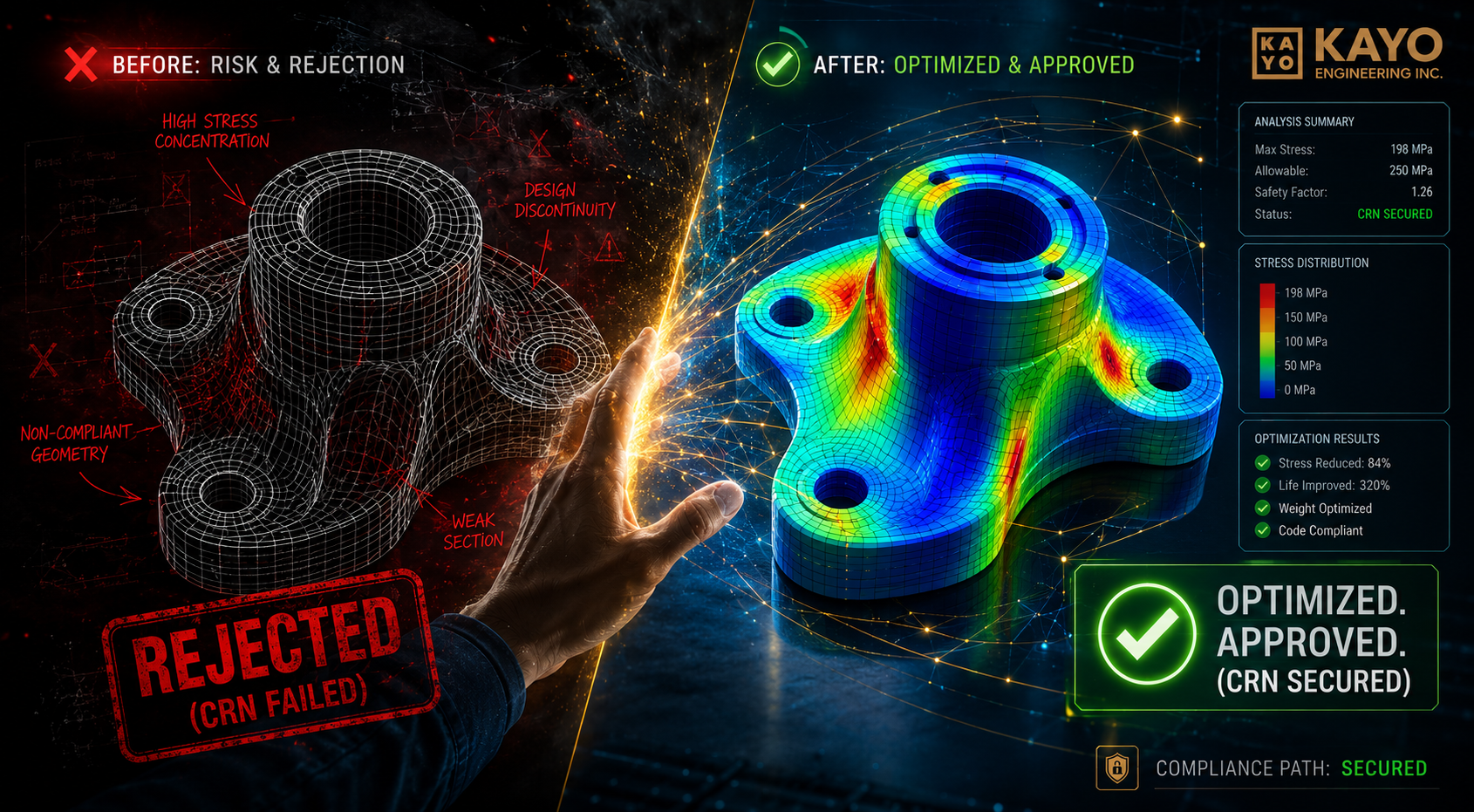
Standard code calculations form the absolute foundation of mechanical engineering. Governing bodies, such as ASME and CSA, provide highly reliable