
Blog
The Lifespan Dilemma: Repair, Modify, or Replace?
First and foremost, for fleet operators, highway tanks aren’t just equipment—they are massive capital investments.
Consequently, when an aging tank trailer starts showing signs of structural fatigue, or a lucrative new contract requires you to haul a completely different class of dangerous goods, you face a critical decision. Specifically: Do you spend a fortune on a brand-new tank, or can you adapt the one you already own?
Therefore, the short answer is: Yes, you can alter an existing highway tank.
However, here is the catch. Because these vessels transport hazardous materials at highway speeds, the regulations governing how you cut, weld, and alter them remain fiercely strict.
Moreover, under Transport Canada’s CSA B620 standard (and mirroring U.S. regulations under 49 CFR § 180.413), authorities draw a hard, unforgiving line between a simple “repair” and a complex “modification.” As a result, if you cross that line without proper engineering oversight, you won’t just void your certification. Instead, you will face crippling regulatory fines and render your expensive equipment legally useless.
In addition, throughout this comprehensive guide, we will break down the critical differences between repairing and modifying a legacy highway tank. Furthermore, we will explain the engineering protocols you must strictly follow, and outline the exact steps to extend your equipment’s lifecycle—safely and legally.
📌 Key Takeaways at a Glance
-
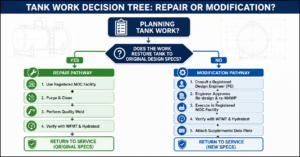
Repair vs. Modification: A repair restores a tank back to its original design specs. Meanwhile, a modification changes the structural design or operational intent of the tank.
-
Facility Registration is Non-Negotiable: You cannot use a local neighborhood welder. Consequently, a Transport Canada Registered Facility (or a National Board “R” stamp holder in the U.S.) must complete all work.
-
Modifications Demand Engineers: For any structural modification, a certified Design Engineer must approve the changes and recalculate the Maximum Allowable Working Pressure (MAWP).
-
Rigorous Post-Work Testing: After any hot work on the pressure-retaining wall, the tank must pass strict hydrostatic testing and NDT (Non-Destructive Testing) before it hits the road again.
Defining the Line: Repair vs. Modification
Initially, the very first step in planning any work on a cargo tank trailer involves correctly classifying the scope of the project. Unfortunately, misclassifying a complex modification as a simple repair remains one of the most common—and expensive—mistakes fleet managers make today.
To clarify, let’s break it down:
| Feature | Tank Repair | Tank Modification |
| Core Definition | Restores the tank to its original registered design specifications. | Alters structural integrity, design concept, or intended method of operation. |
| Real-World Examples | Grinding and re-welding a cracked seam, swapping a damaged valve for an identical one. | “Stretching” the barrel for more capacity, adding internal baffles, upgrading for heated products. |
| Regulatory Needs | A Registered MOC Facility must execute the work. | A Design Engineer must approve it, plus an MOC Facility must execute it. |
The Strict Protocol for Highway Tank Repairs
If your tank has suffered a crack, corrosion, or accident damage, you absolutely can repair it and get it back in service. Nevertheless, compliance remains key.
1. Mandate a Registered Facility
Firstly, you cannot take a dangerous goods tank to a standard commercial fabrication shop. Instead, a facility officially registered with Transport Canada as a Means of Containment (MOC) facility (or holding an “R” stamp in the US) must execute any welding on the tank wall or load-bearing structures.
2. Complete Purging and Cleaning
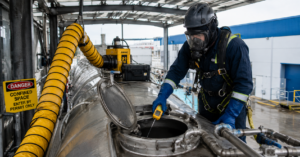
Above all, safety comes first. Therefore, before technicians begin any cutting or welding, they must completely evacuate the tank of hazardous lading and purge all flammable vapors. Furthermore, the law explicitly requires a certified “gas-free” certificate before a welder even thinks about striking an arc.
3. Non-Destructive Testing (NDT) Verification
Afterward, once technicians finish the repair, the work needs definitive proof. For instance, if a welder grinds out and re-welds a crack, the area typically requires Wet Fluorescent Magnetic Particle Inspection (WFMT) or radiographic testing to ensure zero microscopic defects remain. Finally, a hydrostatic pressure test guarantees leak-proof integrity.

The Engineering Protocol for Tank Modifications
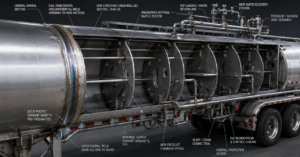
On the other hand, modifying or “rebarrelling” a legacy tank is a completely different ballgame. Because you fundamentally change the tank’s physics, regulators treat modifications almost as strictly as manufacturing a brand-new vessel.
1. Involve a Design Certifying Engineer
First, you cannot modify a tank based on a mechanic’s best guess. Instead, a Registered Design Engineer must analyze and approve the proposed modification in writing. Subsequently, they will calculate structural integrity impacts, verify rollover protection standards, and ensure venting capacity remains mathematically sound.
2. Analyze the Original Design Data
Next, the facility executing the modification needs the original blueprints. This documentation includes structural analysis, material specs, and original welding procedures. What if you lost the manufacturer’s blueprints? In that scenario, the Design Engineer will have to reverse-engineer the tank using 3D laser scanning and ultrasonic thickness testing.
3. Install Supplemental Data Plates
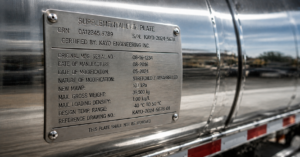
Lastly, when you modify a tank, its original data plate becomes legally inaccurate. Consequently, regulators require you to install a supplemental specification plate right next to the original one. This new plate must detail the nature of the modification, new capabilities, the date, and the MOC registration number.
The Hidden Danger of “Band-Aid” Repairs
Now, consider the most dangerous scenario in fleet management: the undocumented “band-aid” repair.
For example, imagine one of your drivers notices a small weep on a baffle weld. To save time, a local, unregistered mechanic runs a quick weld bead over the crack. Ultimately, the leak stops, and the truck rolls out.
However, from a regulatory standpoint, that tank now represents a massive liability.
Because the mechanic lacked certification, failed to document the weld, and skipped hydrostatic testing, DOT inspectors will subject that tank to an immediate Out-of-Service (OOS) order. Worse still, applying heat to a stress-fractured area without engineering analysis creates a brittle heat-affected zone. As a result, this practically guarantees a catastrophic rupture on the highway.
Actionable Conclusion: Protect Your Assets by the Book
In conclusion, extending the lifecycle of your existing highway tanks through strategic repairs and modifications serves as a brilliant way to optimize capital expenditure. Nevertheless, those financial benefits only materialize if your team executes the work with absolute precision.
Therefore, whether you are patching a stress fracture or stretching a barrel for maximum payload, the rules of CSA B620 and 49 CFR are completely non-negotiable.
Ultimately, partnering with certified Design Engineers and registered fabrication facilities is the only way to ensure your legacy tanks remain safe, highly profitable, and entirely immune to regulatory fines.
Are you ready to safely modify or repair your cargo tank?
Above all, do not risk your DOT certification on undocumented welding. [Insert Link: Contact our certified engineering and repair team today] to evaluate your tank, engineer a fully compliant modification plan, and keep your fleet legally on the road.
Finite Element Analysis for Complex Geometries: The Ultimate Guide
Standard code calculations form the absolute foundation of mechanical engineering. Governing bodies, such as ASME and CSA, provide highly reliable
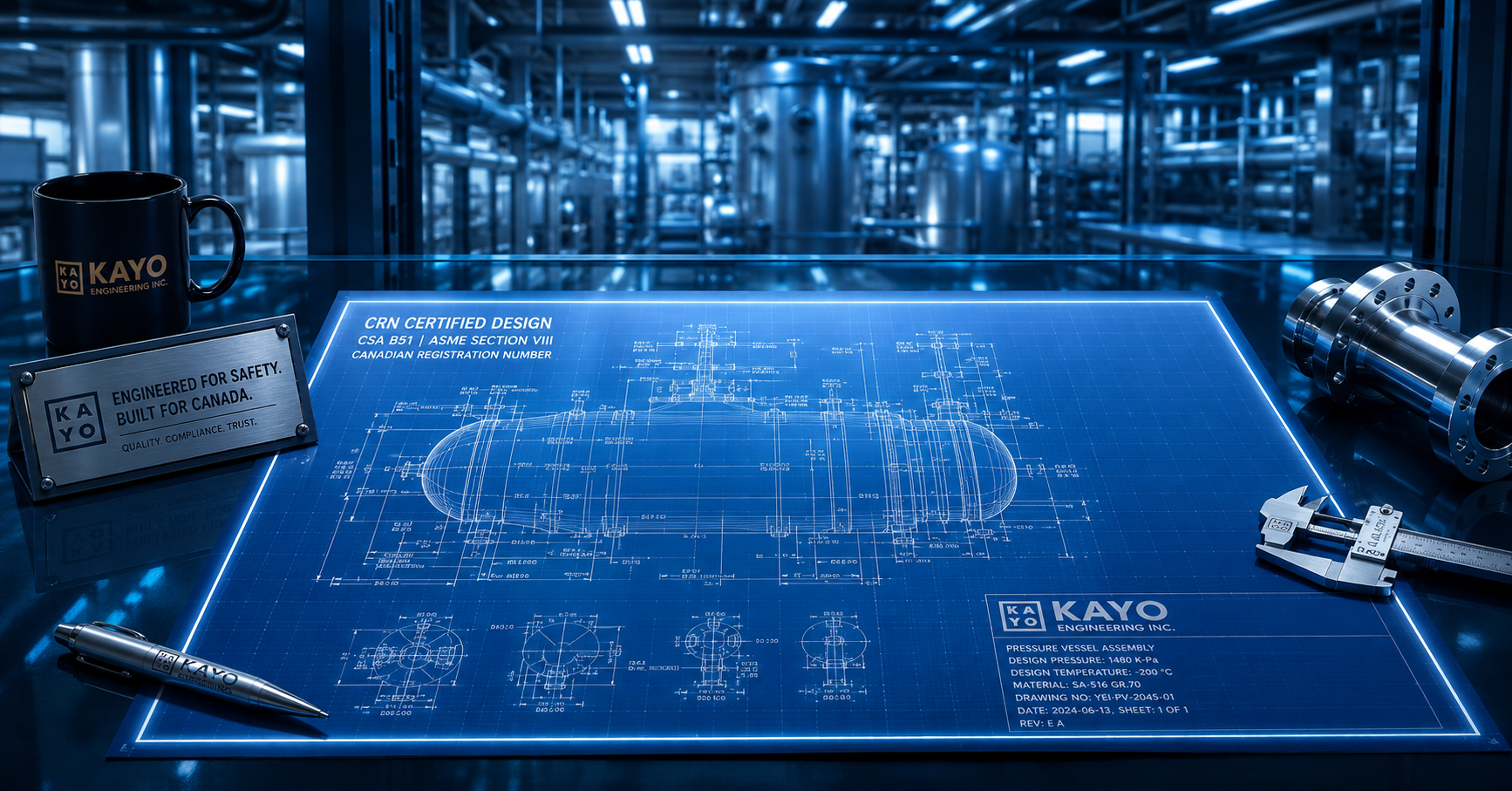
The Ultimate Guide to Securing a Canadian Registration Number (CRN) Without the Headaches
Introduction: Why CRN Approval Matters For OEMs, EPC contractors, manufacturers, and industrial facility owners, getting pressure equipment into service in
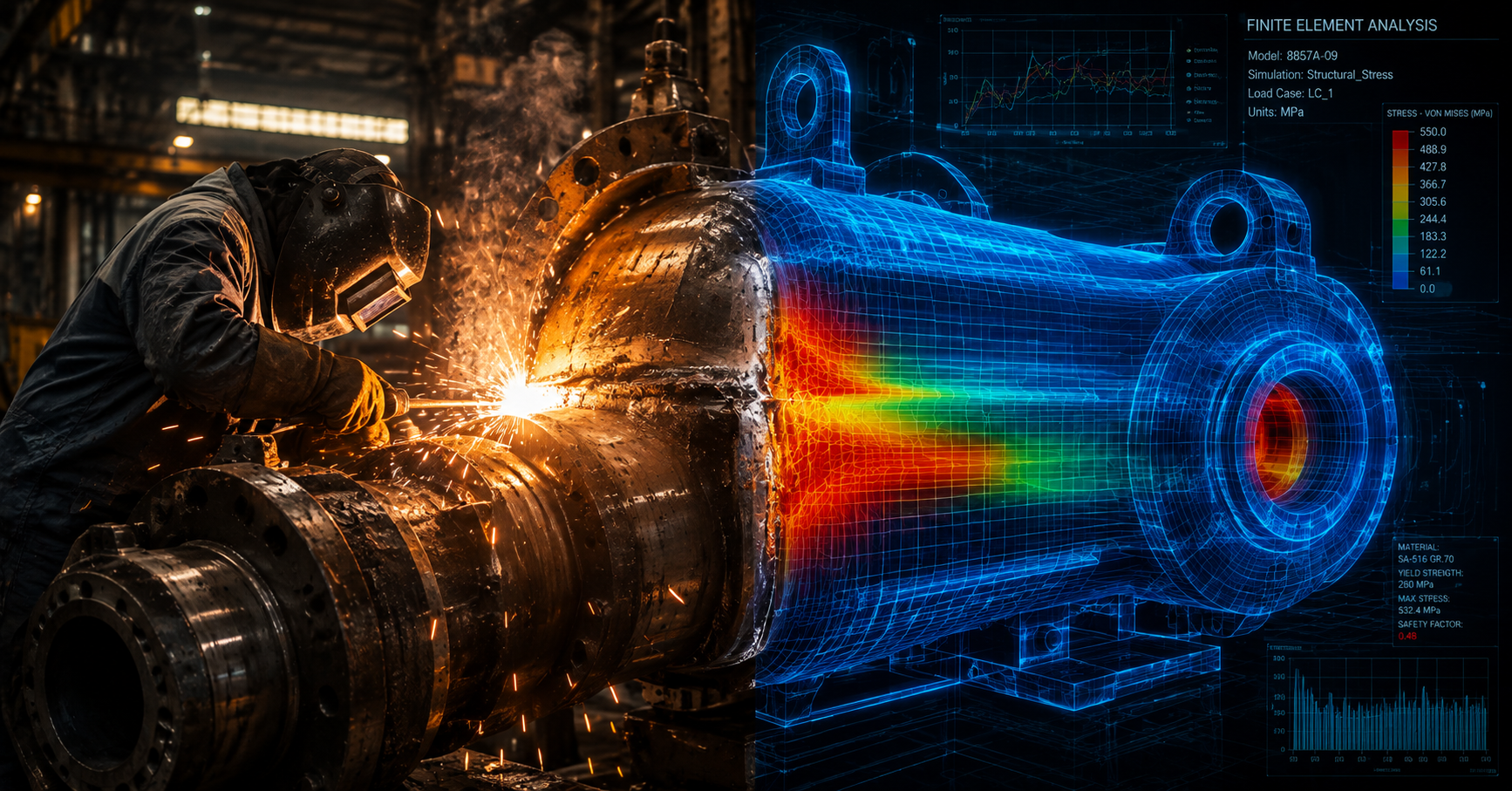
Industrial Equipment Modification: The Hidden Risks & Solutions
Upgrading your existing machinery seems like the ultimate cost-saving hack. But making structural changes without rigorous engineering validation? That transforms